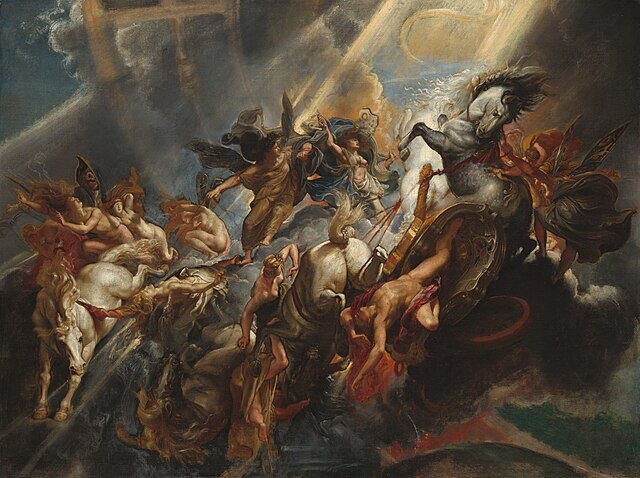
Mythology forms the bedrock of classical education by immersing those who study it in the foundational narratives of Western civilization. If we choose to take away mythology, the Greco-Roman tradition would collapse. Myths are not mere fairy tales but the primary lens through which ancient peoples understood their world — from the heroic quests of Odysseus to the divine interventions of Zeus.
Studying these stories equips learners with essential cultural literacy, enabling them to decode allusions from Homer's Iliad, Virgil's Aeneid, and countless others in the works of Dante, Shakespeare, and Milton. A child who has fought with Achilles, roamed the seas with Odysseus, and escaped the fall of Troy with Aeneas will recognize the hidden treasures that mythology gives a student throughout his life — treasures that so many will never grasp.
Mythology ignites intellectual creativity and linguistic mastery, essential to the trivium's progression from grammar to rhetoric. Etymological treasures abound — words like chaos, tantalize, echo, narcissism, and titanic derive directly from myths — while the archetypal patterns in these stories train students in symbolic thinking and persuasive storytelling. Listening to these rich stories hones the imagination required for original composition and critical interpretation, skills that elevate rhetoric from mere technique to eloquent expression.
Paideia, or classical education, seeks to form whole persons capable of wonder and wisdom; mythology supplies that spark, bridging the poetic and the rational. By preserving these ancient wonders, it ensures graduates emerge not as provincial minds, but as culturally fluent thinkers equipped to navigate and enrich the modern world.
Without this knowledge, students encounter a fragmented literary heritage; with it, they grasp the continuity of ideas across millennia, recognizing how myths shaped philosophy, politics, and ethics. This historical depth fosters a profound appreciation for the roots of democracy, law, and human inquiry, transforming education from rote memorization into a living dialogue with the past.
Beyond cultural context, mythology cultivates moral reasoning and character formation. Through tales of hubris punished in Icarus or justice upheld by Athena, students confront timeless dilemmas about fate, free will, courage, and temptation — lessons far more vivid and memorable than abstract treatises.
Narratives of mythology invite rigorous Socratic analysis: why did Prometheus defy the gods, and what does that reveal about innovation versus order? Such inquiry sharpens ethical discernment, mirroring the classical goal of producing not just knowledgeable but wise individuals.
In one of my favorite essays I have ever read, Cheryl Low from Memoria Press writes:
"We are all Greeks when we come to God: searching, asking, debating, questioning, doubting, wondering. The Greeks are our guides because they asked all of the right questions, and asking the right questions is half the battle. And they explored answers with a depth and insight that is astounding. It was Cicero, building on this Greek inheritance, who led St. Augustine to Christ. It was Vergil, using Homer as his model, who led Dante up to the gates of Heaven. The pagan classics can do the same for us."
Cheryl Low, Memoria Press
In an era of moral relativism, mythology offers a tested framework for debating right and wrong, encouraging students to internalize virtues like resilience and piety while confronting human flaws — thereby building the resilient character that classical educators have prized since antiquity.
As C. S. Lewis reflected on his dear friend Tollers' work, in an essay entitled Tolkien's The Lord of the Rings in the magazine Time and Tide in 1954, he wrote:
"The value of myth is that it takes all the things we know and restores to them the rich significance which has been hidden by 'the veil of familiarity.' The child enjoys his cold meat (otherwise dull to him) by pretending it is buffalo, just killed with his own bow and arrow. And the child is wise. The real meat comes back to him more savoury for having been dipped in a story; you might say that only then it is the real meat. If you are tired of the real landscape, look at it in a mirror. By putting bread, gold, horse, apple, or the very roads into a myth, we do not retreat from reality: we rediscover it. As long as the story lingers in our mind, the real things are more themselves."
C. S. Lewis, Time and Tide (1954)
I cannot think of a time in history more desperately in need of a generation capable of thinking clearly and making wise and rational decisions. In the coming years, there will be problems that arise that will feel mythical in nature — so hard to grasp they seem unreal. But we will have raised a generation that does not quake at the first signs of trouble, one that has been steeped in the stories of great men and women who battled their giants and fought on the side of the righteous.