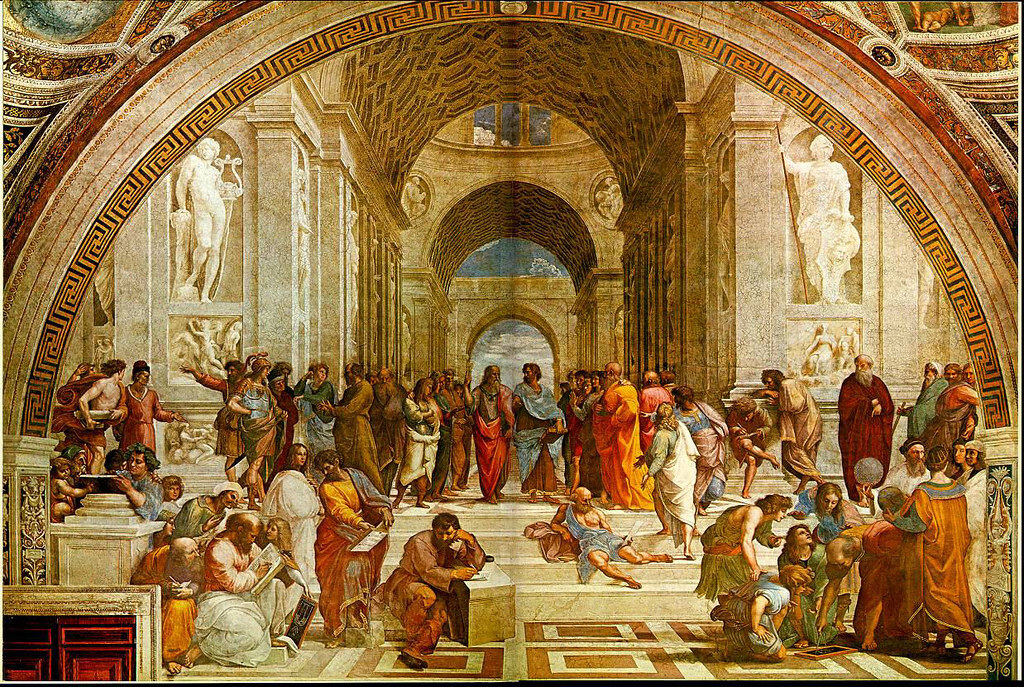
Paideia (παιδεία), an ancient Greek term often translated as discipline, education, nurture, or upbringing, encompassed far more than formal schooling; it represented the holistic process of shaping an individual into an ideal member of society.
Rooted in the word for child (pais or παῖς), paideia aimed to cultivate physical, intellectual, moral, and aesthetic excellence, producing the well-rounded person embodying kalos kagathos (καλός καγάθος) or the beautiful and good. This involved a balanced curriculum that included gymnastics and athletics for bodily strength and discipline, alongside studies in music, poetry, rhetoric, grammar, mathematics, philosophy, and ethics to refine the mind and soul.
Thinkers like Plato and Aristotle emphasized paideia as essential for virtuous citizenship, where education served not just personal development but the harmony and flourishing of the community — molding individuals to live justly, reason critically, and contribute meaningfully to civic life. Stories weren't just simple entertainment — they were windows into the soul, a tool for moral character development.
Jaeger Werner wrote in his seminal work, Paideia: The Ideals of Greek Culture:
"The Greeks realized that they could shape people as a potter molded clay. ‘They were the first to recognize that education means deliberately molding human character in accordance with an idea.’"
Werner Jaeger, Paideia: The Ideals of Greek Culture
In its broader philosophical and cultural sense, paideia transcended mere instruction to become synonymous with the formation of genuine human nature and the carrying forward of civilization. It embodied a humanistic ideal — later echoed in the Roman concept of humanitas — that sought to realize humanity's highest potential through lifelong cultivation of virtue, wisdom, and beauty.
In the New Testament we find a reference to paideia, in Ephesians:
"And, ye fathers, provoke not your children to wrath: but bring them up in the nurture and admonition of the Lord."
Ephesians 6:4
That word nurture is paideia. When Paul is instructing us on how to raise our children, he tells us to use the philosophy of paideia. Again in 2 Timothy, we read Paul's words to his spiritual son, Timothy:
"All scripture is given by inspiration of God, and is profitable for doctrine, for reproof, for correction, for instruction in righteousness."
2 Timothy 3:16
Instruction — that is paideia once again.
Today, we see paideia inspire approaches that prioritize character, critical thinking, and cultural depth — reminding us that true education is not just about collecting all the facts and figures.
The concept of paideia, as David V. Hicks articulates it in Norms & Nobility, restores an ancient wholeness to education that modern systems seem to have completely destroyed. By blurring the line between knowing and doing, paideia refuses to treat intellectual mastery as an end in itself.
Instead, genuine learning awakens a sense of moral responsibility: to know the good is to feel compelled to pursue it, to embody it in action, and to shape one's character accordingly. As Paul reminds us, we must call our families to more. We are the conduit between the inspiring idea and the society that is changed by those very living ideas.
This integration echoes the classical vision where education forms not just the mind but the whole person — intellect, will, and affections aligned toward virtue. When knowledge remains abstract or merely accumulated, it risks becoming sterile or even dangerous; true paideia demands that insight translate into courageous, creative living, turning the educated individual into an agent of renewal rather than a passive observer.
This obligation to act independently and creatively carries profound implications for personal and communal life. In a world that often rewards specialization and credentials, the paideia ideal insists that learning must bear fruit. It calls parents to apply wisdom with patience and vision, employees to work with integrity and service, and citizens to show generosity and speak truth. Being "learned" without this active dimension falls short — it produces the dilettante or the cynic rather than the noble soul Hicks describes.
The hope embedded in the Paideia Collection is precisely this: that encounters with great ideas, timeless texts, and living histories will not end in admiration alone but will stir hearts to purposeful motion. Families who engage deeply find their domestic life enriched — conversations deepened, habits reformed, love expressed more fully — as the boundary between study and service dissolves.
Ultimately, this vision radiates outward from the individual and the family to the broader community. When parents and children alike take what they have learned and live it out — whether through acts of hospitality, civic involvement, artistic creation, or quiet perseverance — they become channels of grace in a fragmented society. The family, nourished by paideia, ceases to be an insular unit and instead serves as a seedbed for cultural renewal, modeling the very harmony of knowing and doing that the world desperately needs. In this way, the pursuit of classical education transcends personal enrichment; it becomes a quiet revolution — where strengthened individuals and families quietly rebuild the common good, one faithful action at a time, fulfilling the ancient promise that true nobility flows from the values embraced and enacted through the transformative power of paideia.